
Reported by Giovanni Legorano
(Excerpt shown below. To read full report, go to: https://foreignpolicy.com/2025/07/15/chinese-bankers-money-laundering-europe-world/)
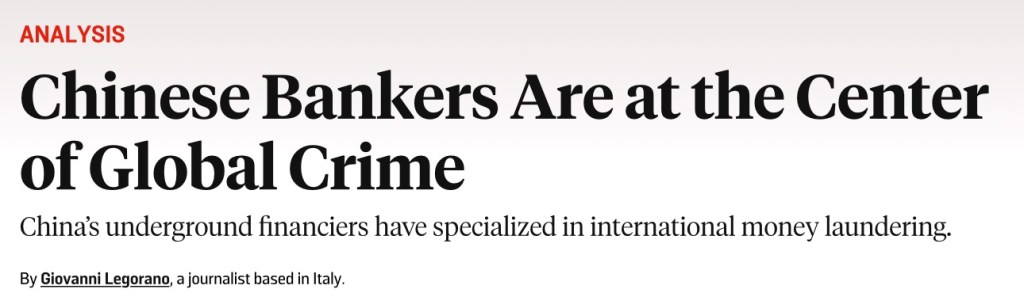
Three separate police investigations in Italy recently uncovered around 1 billion euros in proceeds from drug trafficking of the Calabrian ‘Ndrangheta, Colombian drug cartels, and Albanian organized criminal groups. The more important finding may have been who it was determined had laundered the illicit money: Chinese underground bankers.
These cases illustrate how Chinese shadow brokers have emerged as the money launderers of choice of the world’s transnational criminal networks, facilitating payments across continents and cleaning up the proceeds of serious criminal activities. The increasing use of this system by criminals around the world is alarming European and U.S. authorities. The flows of money are particularly hard to spot, as the cash isn’t physically moved from one country to another and there is largely no paper trail.
“The use of idioms that are difficult to understand, the extreme mobility of the individuals involved, and the capacity to operate make Chinese criminality hard to repress effectively,” Italy’s national anti-mafia agency, the DIA, said in its 2025 mission report.
The DIA said Chinese criminals managed to create over time a full-fledged illegal banking system, based on fei chien, or flying money, which enables users to transfer money from one point to another entirely on the basis of trust.
The centuries-old system involves depositing a sum with a money broker in one country while another agent in the network elsewhere in the world pays the equivalent amount to the intended recipient. Brokers make money charging commissions and frequently also on the exchange rate. The transfers can happen almost instantly.
The transaction is then balanced out at a later stage through flows of money in the opposite direction, through the physical exchange of cash or other valuables—including cryptocurrencies, as it emerged from a number of recent cases—or through trade-based money laundering.
Fei chien works substantially in the same way as hawala, another money transfer method common in other parts of Asia, the Middle East, and Africa, which has also been abused by criminals around the world.
They both rely on tight-knit communities of individuals, almost impenetrable to outsiders, where trust among brokers and users allows the smooth functioning of these systems.
 Financial Crime News Briefs