
Reported by Eve Sampson
(Summary version featured below)
In a quiet Maryland suburb, Pari Ibrahim spends her nights searching for traces of lost Yazidi women. As the executive director of the Free Yezidi Foundation by day, she transforms into an investigator by night, sifting through hundreds of photographs of missing girls and women kidnapped by the Islamic State a decade ago. Families desperate for answers send her childhood photos of daughters who vanished in 2014, while other sources provide images of women—faces hardened by time—who might be those same girls, now trapped in captivity. It is a painstaking and emotional process, one in which small details—a lip shape, a birthmark—might be the only link between past and present.
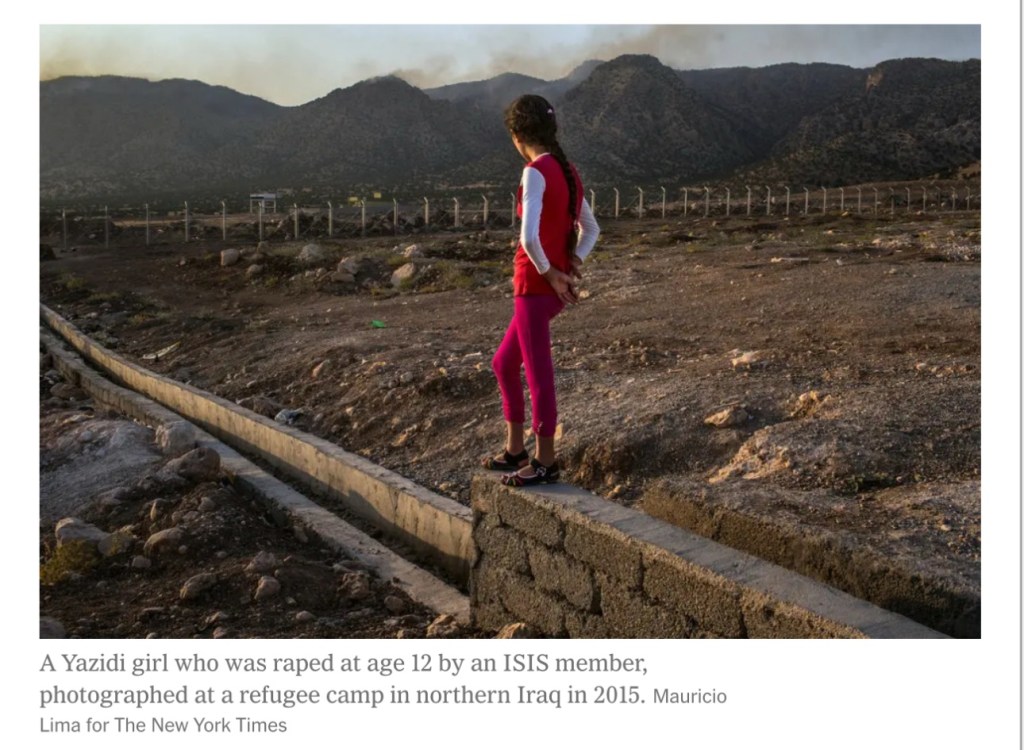
The Yazidis, a religious minority in Iraq, were among the primary victims of ISIS’s brutal campaign of genocide. In August 2014, militants stormed their communities, killing thousands and enslaving many more, particularly women and children. While ISIS’s self-declared caliphate was officially defeated years ago, nearly 2,600 Yazidis remain unaccounted for, with some estimates placing the number closer to 3,000. Many are presumed dead, but activists like Ibrahim believe some still endure captivity, trafficked across the Middle East, integrated into militants’ families, or hidden in detention camps. With no official effort to locate them, a network of Yazidi activists and informants has stepped in, working in secret to bring the missing home.
Among them is Abduallah Abbas Khalaf, who first rescued his niece from ISIS in 2014 using connections made as a beekeeper in Syria. He later devised a strategy of infiltrating ISIS-controlled online marketplaces, posing as a buyer to gather intelligence on kidnapped women. He and others in the underground rescue network shared stories of trafficked Yazidi girls being bought and sold in hidden channels long after ISIS’s formal defeat. Screenshots from these forums show men haggling over “slaves,” some as young as children, reinforcing the grim reality that for many captives, the nightmare never ended. Experts say the practice continues in secrecy, with women smuggled across borders to distant locations, including Turkey and Gaza.
Even in the aftermath of ISIS’s territorial collapse, Yazidis continue to face unimaginable challenges. Some freed captives, like Sherine Hakrash, were separated from their children, leaving them with little hope of reunion. Others, such as those imprisoned in Al Hol, a sprawling detention camp in Syria, live in fear of revealing their Yazidi identity amid ISIS loyalists. The camp has become a new prison for those who once suffered at the hands of ISIS, with reports of continued enslavement and violence. Rescue efforts are often hindered by the victims’ fear, uncertainty, and the complexity of their circumstances—some were kidnapped so young they no longer recognize their own heritage.
Despite these challenges, some Yazidi survivors have found paths to freedom and a new life. Marwa Nawaf Abas, kidnapped and sold multiple times as a sex slave, managed to escape her captors in Syria and, with the help of smugglers, made her way to safety in Germany. Now working at a hair transplant center, she has begun to rebuild her life. But for thousands of others, the search continues, driven by people like Ibrahim and Khalaf, who refuse to let the world forget those still trapped in the shadows of war.
Read original version: https://www.nytimes.com/2025/02/16/world/middleeast/isis-women-kidnapped.html
 Financial Crime News Briefs