
Reported by Alexandra Stevenson
(Summary version featured below)
Days before Donald J. Trump’s inauguration as President, tensions between China and the United States escalated, with China issuing a series of retaliatory measures targeting American industries. These included a potential investigation into U.S. chipmakers, sanctions against an American retailer, and plans to impose duties on industrial plastics imports. These actions serve as a warning to the incoming administration, highlighting Beijing’s intent to resist U.S. economic pressure and demonstrate its leverage in the ongoing trade and technology conflicts.
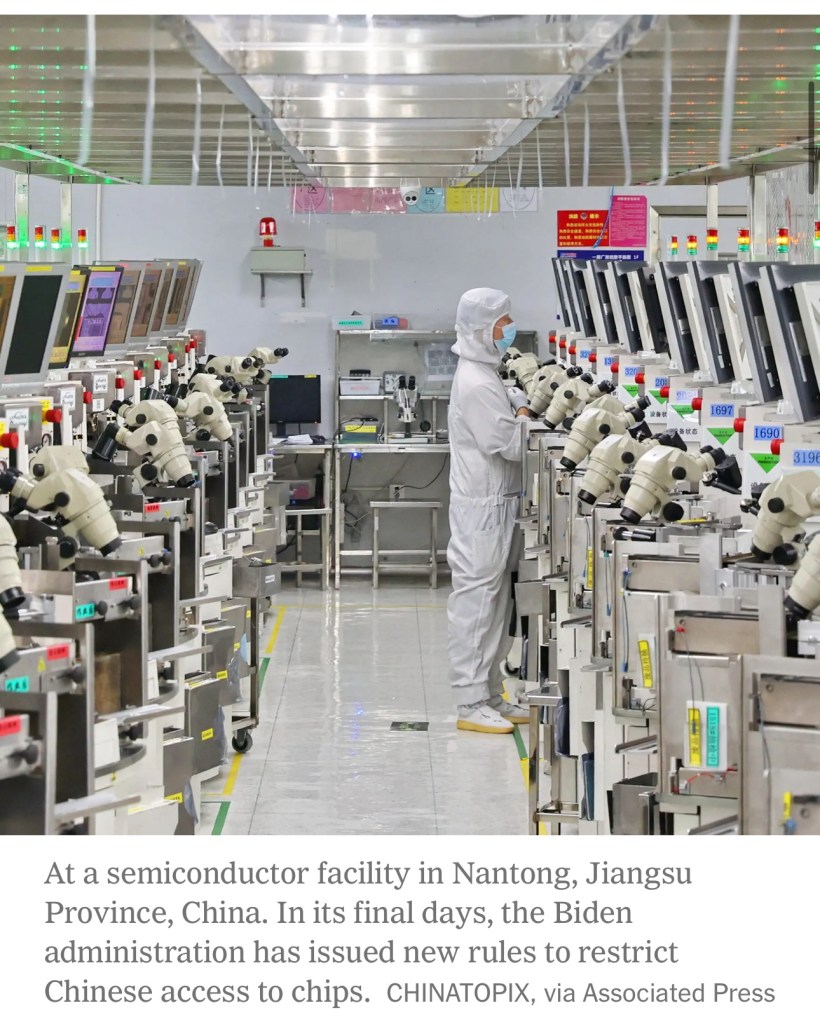
The Biden administration, in its final days, implemented stringent measures aimed at restricting China’s access to critical technologies like semiconductors while penalizing companies in industries such as mining and renewable energy. Dubbed “China sanctions week,” these actions reflect Washington’s broader strategy to curb China’s economic and military influence. In response, Beijing’s rhetoric and actions have grown increasingly combative, emphasizing its commitment to self-reliance and defending its sovereignty against what it perceives as coercive U.S. policies.
China’s recent moves include an investigation into American chipmakers like Nvidia and Intel, accusing them of unfair practices underpinned by subsidies from the U.S. CHIPS and Science Act. Chinese regulators have also targeted Micron, barring it from much of the Chinese market. This mirrors U.S. concerns over China’s state-backed industrial policies, as both nations escalate their economic rivalry with increasingly similar tactics.
Additionally, China scrutinized the American retailer PVH, accusing it of violating laws related to Xinjiang, a region at the center of U.S.-China human rights tensions. This followed the Uyghur Forced Labor Prevention Act, under which the Biden administration has blocked imports from dozens of Chinese companies. Beijing has countered by passing laws prohibiting compliance with foreign sanctions, putting companies like PVH at risk of being blacklisted in China, further heightening bilateral tensions.
As President-elect Trump prepares to take office, some analysts believe China’s recent actions are part of a strategy to test and influence his administration. Beijing’s mix of punitive measures and diplomatic gestures, such as sending Vice President Han Zheng to Trump’s inauguration, reflects a calculated approach to manage relations. This “carrot and stick” strategy signals China’s willingness to both engage in negotiations and retaliate if provoked, setting the stage for a contentious U.S.-China relationship under the new administration.
Read full report: https://www.nytimes.com/2025/01/17/business/china-us-trade-sanctions.html
 Financial Crime News Briefs