
Reported by Remy Tumin
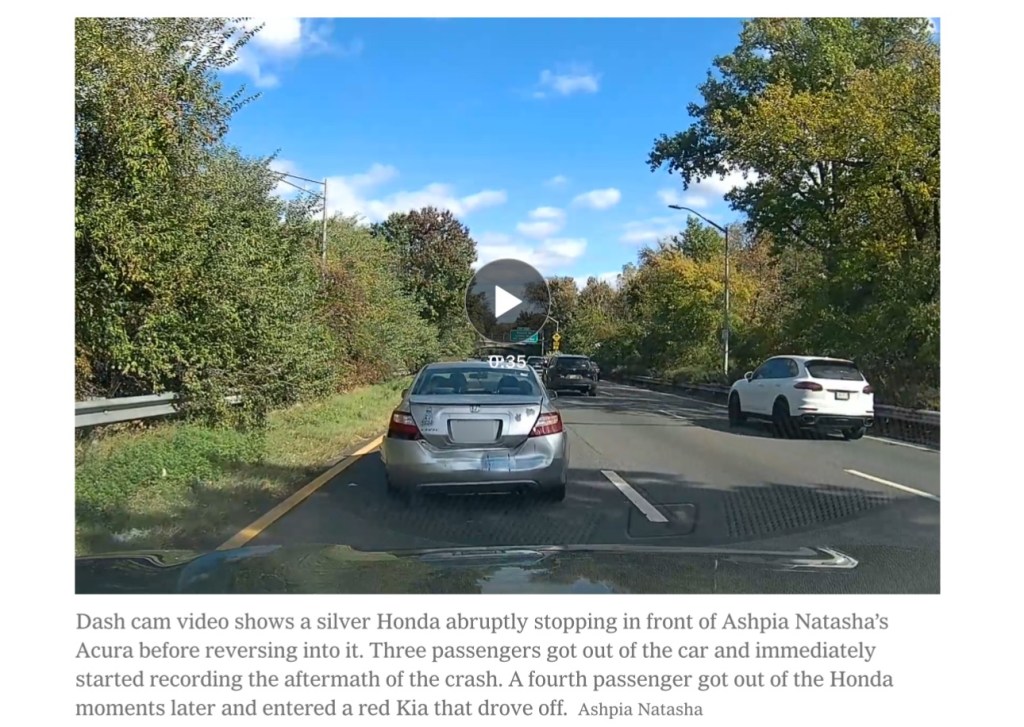
Ashpia Natasha was heading to Long Island to run errands last Wednesday when a Honda Civic cut her off in the left lane on the Belt Parkway. She slammed on her brakes and came to a complete stop.
Seconds later, the Honda abruptly went into reverse, slamming into her Acura, and pulled forward again, a dash cam video shows. Could it have been road rage, Ms. Natasha wondered? But she hadn’t passed anyone or had any issues.
The video then showed four people getting out of the silver car, holding their heads as though they had been injured and immediately taking out their phones to take pictures of Ms. Natasha’s car.
“It all happened so fast,” she said, thinking, “Maybe they’re here to hurt me.”
Now she and experts believe it was something else entirely: an attempt at insurance fraud. The incident is what the National Insurance Crime Bureau, an industry group that tracks insurance claims, called “a perfect example of an attempted insurance fraud scheme playing out in real time.”
Ms. Natasha, 31, uploaded the dash cam videos to TikTok in a post that has been viewed more than 67 million times.
Ms. Natasha was not injured in the accident. Her car sustained $8,300 in damages, which insurance is paying for, she said. In a statement, the New York Police Department said the fraudulent collision investigation squad, part of the department’s Criminal Enterprise Investigation Unit, was investigating the incident. It was not clear who the other car’s occupants were or whether they had made a statement about the collision.
A 2019 law made it a felony in New York to stage a car crash for insurance purposes.
It wasn’t until Ms. Natasha got home and reviewed the dash cam footage that she was able to put pieces together.
A ‘swoop and squat’ and other staged car collisions.
The National Insurance Crime Bureau describes Ms. Natasha’s case as a version of a “swoop and squat,” in which two cars’ drivers conspire to stage an accident and make it appear as though it is your fault.
But there are other types of staged accidents, including a “left or right turn drive down,” in which a set of drivers wave a driver to make a turn, block their way and crash into the side of their car; and a “curb drive down,” when a driver pulls away from a curb and merges into traffic, only to be deliberately crashed into.
In a statement, the trade group said that it was hard to measure how frequently these kinds of accidents occur, but that they were “aware that complex criminal rings are engaging in this behavior.”
Read full report: https://www.nytimes.com/2024/10/23/us/queens-dash-cam-crash-belt-parkway-insurance.html?searchResultPosition=3
 Financial Crime News Briefs