
Reported by Will Freeman, Steven Holmes and Mariana Fernandez Rubach
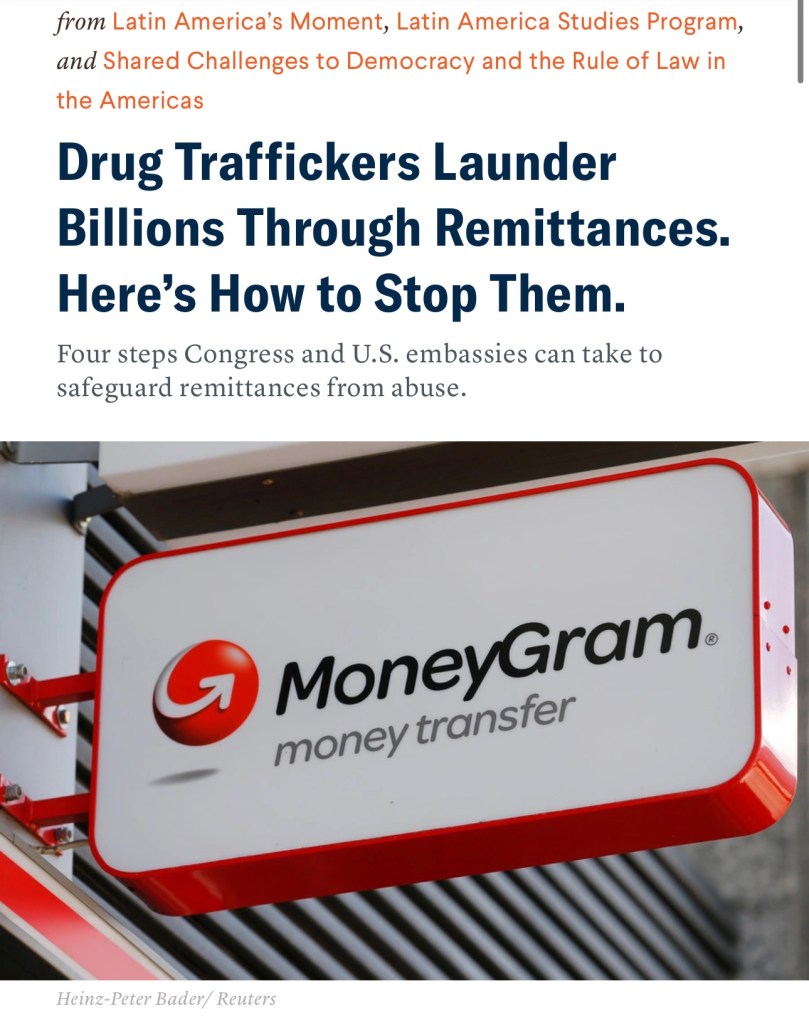
Forget corrupt banks. Drug cartels have a new favorite tool for laundering money—remittances sent via services like Money Gram and Western Union.
Lax government oversight allows cartels to launder billions through remittances annually. But it doesn’t have to be this way. Congress and U.S. embassies can take steps now to curb the practice and make it harder for fentanyl traffickers and others to refinance.
In 2023, Latin America received a record-setting $155 billion in remittances, primarily from senders living in the United States. Most senders are hard-working families, and most remittances to Latin America—which have doubled over the past decade—are a force for good, boosting consumption in Central America and the Caribbean.
Latin America’s Moment
Latin America’s Moment analyzes economic, political, and social issues and trends throughout the Western Hemisphere. 1-3 times weekly.
But as remittance flows have grown, transnational organized crime groups (TOCs) have also learned how to exploit them—namely as a tool for covertly cleaning and moving the proceeds of their drug sales on U.S. streets back to Latin America.
TOCs coerce or bribe U.S. citizens and residents without criminal records into mixing drug proceeds with clean cash destined for recipients in the region. Those recipients then transfer the money to TOCs’ local contacts. This is big illicit business. Signos Vitales, a Mexican NGO, estimates that criminal groups’ money accounted for at least seven percent of the record $58.5 billion sent in remittances to Mexico in 2022.
While money laundering via banks has gotten harder in recent years, laundering through remittances remains all too easy. Most remittances are sent through non-banking financial intermediaries known as money services businesses (MSBs), like Western Union. MSBs are subject to almost no regulation and require only basic, easily falsifiable personal information. And because they typically rely on financial and electronic funds rather than banks to conduct money transfers, they bypass the U.S. financial system’s “know your client” rules and money-laundering alarm systems.
All that makes money laundering via remittances hard to control—but it’s not impossible. Here are four steps the U.S. government can and should take now.
Pass the Remittances and Money Laundering Risk Assessment Act
This bill, introduced in 2019 by Senator John Cornyn (R-TX), would address one of the biggest current hurdles: the lack of information about remittance-based laundering. It tasks the U.S. Department of Treasury with reporting to Congress on TOC use of remittances and developing a government strategy to curb the practice. Days after its introduction, the bill was incorporated into a larger anti-money laundering bill, the Combating Money Laundering, Terrorist Financing, and Counterfeiting Act. Senators Cornyn, Klobuchar (D-MN), and Grassley (R-IA) reintroduced that act in 2022, and again in January 2024, but it hasn’t yet made it past the Senate Committee on the Judiciary.
Lawmakers, including on that committee, should do what it takes to pass the bill in the next congress. They should also pass the Establishing New Authorities for Businesses Laundering and Enabling Risks to Security (ENABLERS) Act, which would make non-bank businesses and professions, including third-party payment services, subject to the same anti-money laundering regulations and procedures as banks. Bipartisan support for the 2021 Corporate Transparency Act proves it can be done.
Read full report: https://www.cfr.org/blog/drug-traffickers-launder-billions-through-remittances-heres-how-stop-them
 Financial Crime News Briefs