
Reported by By Daniel Knight and Kithmin Ranamukhaarachchi
Around the world, the fight against money laundering and terrorism financing is ramping up in response to the emergence of ever-more sophisticated criminal networks and infrastructure. The Financial Action Task Force, a global intergovernmental organisation, established a set of standards and provided recommendations to all governments to consider and implement for detecting and preventing money laundering. The Australian government has now introduced the Anti-Money Laundering and Counter-Terrorism Financing Amendment Bill 2024 (Bill) to parliament which proposes to overhaul Australia’s existing anti-money laundering and counter terrorism financing (AML/CTF) regime.
The overhaul, expected to take effect in Q1 in 2026, will bring certain precious stones and metals dealers and jewellery retailers within scope of the AML/CTF regime. As a result, these businesses will be required to establish controls to identify and mitigate money laundering and terrorism financing (ML/TF) risk.
Crucially, these laws apply to such business that accept virtual currencies and large sums of cash for products like diamonds and gold.
In-Scope Dealers and Jewellers
The Bill proposes to capture businesses that buy or sell “precious metals”, “precious products” or “precious stones” where a payment of more than AU$10,000 is made in physical currency or virtual assets (eg bitcoin and stablecoins) or a combination of both. This will include a series of transactions that are linked or appear to be linked.
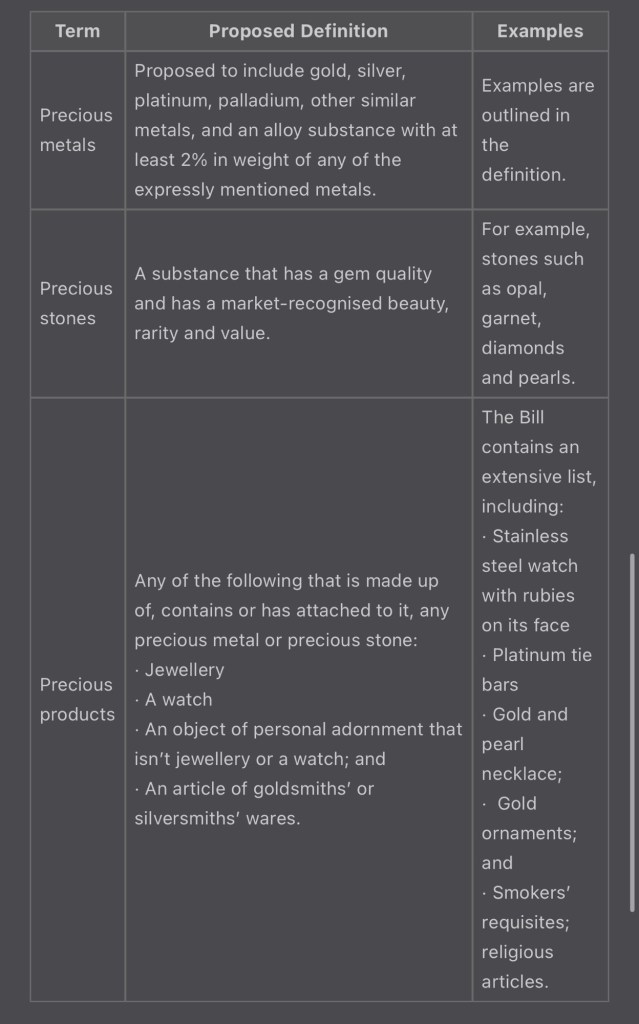
The definitions of “precious metals”, “precious products” or “precious stones” are broad. As you will see in the definitions outlined in the following table, a lot of luxury products and dealers of those products will be captured.
Obligations of In-Scope Businesses
Whilst the obligations under the AML/CTF regime are extensive, the goal is clear: identify and mitigate money laundering risks. To achieve this goal, in-scope businesses are required to (among others):
- Conduct and document a comprehensive ML/TF risk assessment;
- Implement proportionate controls to mitigate such risks;
- Ensure there is adequate oversight of the AML/CTF function of the business;
- Conduct customer due diligence and verify identities prior to providing services; and
- Make reports to the Australian Transactions Reports and Analysis Centre (AUSTRAC).
Originally published via: https://www.fashionlawwatch.com/2024/10/14/anti-money-laundering-and-fashion/
 Financial Crime News Briefs