
Reported by Matthew Goldstein
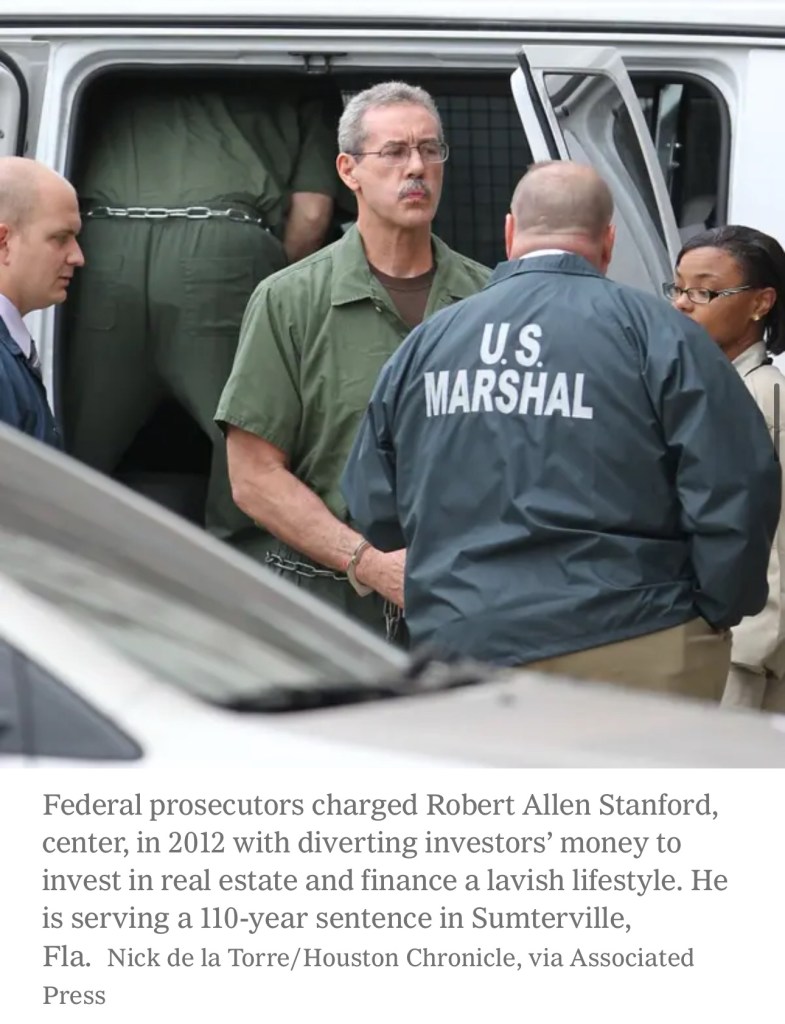
It has been 15 years since Thomas Swingle first learned that about $1 million of his family’s savings had gone up in smoke, after the financier Robert Allen Stanford was exposed for having sold billions in fraudulent certificates of deposit to investors around the world.
The memory of those days is still painful.
“It was literally a life-changing event,” Mr. Swingle, 72, said of the $7 billion scheme, which unraveled in early 2009. “It is like someone hit you in the chest with a sledgehammer.”
Now, victims of Mr. Stanford’s company, Stanford Financial, are on the verge of recouping some of their losses, but Mr. Swingle and his wife, Cindy Finch, have to contend with another decision they made: In 2021, they agreed to sell their claim to any future settlement to an investment fund for around $60,000.
That means they won’t get a penny of the funds that are about to be disbursed. Instead, they will all go to the claim buyer.
It’s a decision fraud victims have to agonize over in the wake of a big financial scam: Large investors offer them cash in exchange for the rights to any future payment. Many small investors who don’t have much insight into what might happen next may feel they don’t have a choice but to settle for a quick lump sum, rather than wait for a future payment that may never come.
When Mr. Swingle and Ms. Finch sold their claim, he said, it appeared Stanford’s defrauded customers were unlikely to get anything back at all. Had the couple held on to the rights, they might be able to claim as much as $350,000.
“It didn’t turn out good for us,” Mr. Swingle said, “but you got to move on.”
Mr. Stanford’s scheme involved high interest rate certificates of deposit. His firm was based in Houston, but the certificates were issued by a bank in Antigua, which meant customers’ deposits weren’t federally insured in the United States.
Even though Mr. Stanford had offered little information into how he could offer higher than normal returns, his firm had the trapping of success and wealth — private jets, fancy homes and sports sponsorships — that put even wary customers at ease. In the United States, Mr. Stanford employed an army of brokers to aggressively peddle the certificates.
The whole endeavor collapsed suddenly in February 2009, amid investigations by the Securities and Exchange Commission and other agencies, and after a Bloomberg Businessweek article raised questions about how the firm operated. Two months earlier, Bernard Madoff had turned himself in to federal authorities for running a much bigger Ponzi scheme.
Read full report: https://www.nytimes.com/2024/10/07/business/stanford-financial-fraud-victims-paid.html
 Financial Crime News Briefs