
Reported by Lisa Cavazuti
For much of his career as a federal drug agent, Ray Donovan had a singular focus: the capture of Mexican cartel boss Joaquin “El Chapo” Guzman. When Guzman was finally arrested in early 2014, fentanyl trafficking was on the rise in the U.S., and Donovan soon found his next project.
He enlisted a data scientist in an effort to map out the fentanyl networks operating on the East Coast. Reviewing the telephone records of suspected traffickers, investigators saw a pattern of activity that shocked them.
“A ton of calls to China,” recalled Michael Mezner, one of the DEA agents leading the effort. “I looked at that data from every way, and I went to the data guy and told him, ‘I don’t know what’s going on here, but I’ve never seen anything like this in my life.’”
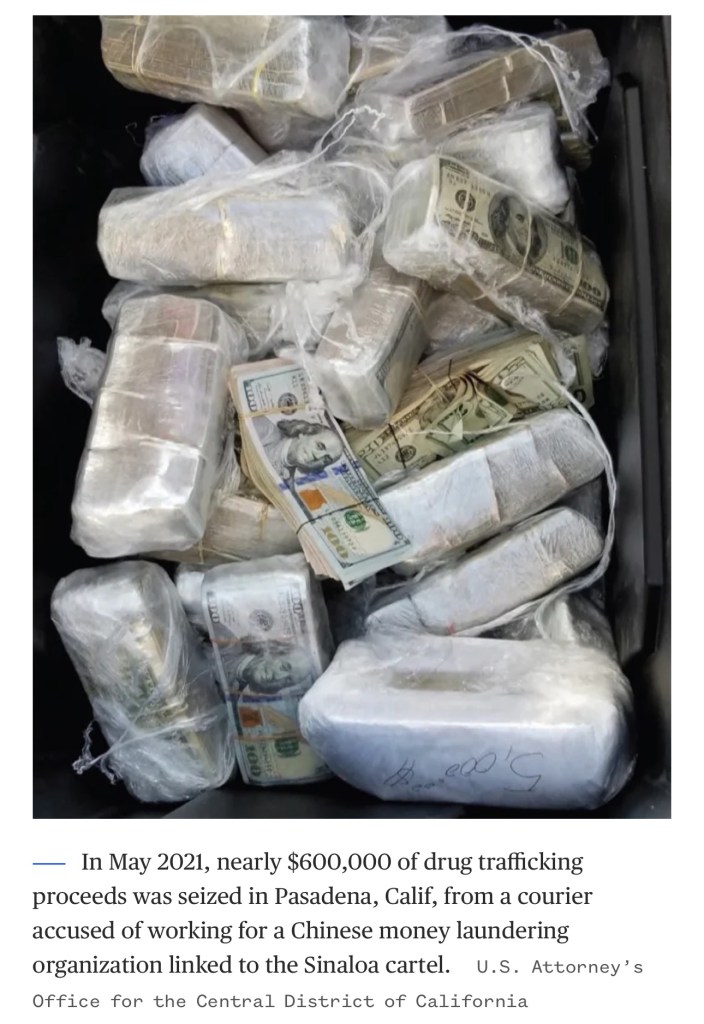
It was a new dynamic: Chinese criminal groups were laundering drug money for the Mexican cartels on an unprecedented scale.
In 2015, Donovan had to turn his attention back to El Chapo after the Sinaloa cartel leader escaped from prison. By the time he was recaptured a year later, investigators digging into the fentanyl trade had made another significant discovery.
The same Chinese brokers who were laundering fentanyl proceeds were now heavily involved in marijuana trafficking across the U.S. as well.
“That was an eye-opening moment,” Donovan said.
What Donovan’s team was first to recognize has national security implications, experts say. Over the past decade, Chinese organized crime groups in the U.S. quietly became the dominant money launderers for Mexican cartels. Then they used the profits to take over the illicit marijuana trade.
The parallel schemes enriched and empowered Chinese criminal groups at a time when marijuana laws were loosening and the Mexican cartels were flooding the country with fentanyl. With U.S. law enforcement agencies focused on busting fentanyl traffickers and suppliers, the Chinese money brokers and marijuana producers operated with relative impunity, according to more than a half dozen retired senior DEA agents.
“It’s two revenue streams that no one else can compete with,” said Christopher Urben, a former assistant special agent in charge at the DEA’s Special Operations Division in Virginia. “They’ve created within the United States, I hate to say it, this super cartel organized crime force.”
The Chinese laundering system has exponentially increased the profits of the two Mexican cartels fueling the fentanyl crisis in the U.S. — the Sinaloa and CJNG. The vast amounts of funds involved also raises national security concerns, according to experts and U.S. lawmakers.
Chinese criminal syndicates are known to operate across the globe with the tacit support of the country’s intelligence services. Current and former American officials fear that at least some of the illicit drug proceeds could be used for nefarious purposes in the U.S. — like corporate espionage or election meddling.
Read full report: https://www.nbcnews.com/news/amp/rcna158030
 Financial Crime News Briefs