
Reported by Albert Torres
After the Oct. 7 attacks on Israel by Iran-backed Hamas, the Biden administration proudly touted its retaliatory crackdown on Iran’s oil revenue. Since 2023, however, Iran has made billions of dollars from its oil industry, using U.S. services and evading U.S. sanctions. And it’s not alone.
The methods used to avoid detection and keep Tehran’s oil export profits consistent aren’t a secret. Front and shell companies hide oil tankers’ true owners; shippers turn to older and defective vessels that don’t use identification systems; ship-to-ship cargo transfers take place in unmonitored zones; and tankers’ locations are disguised by false trade routes.
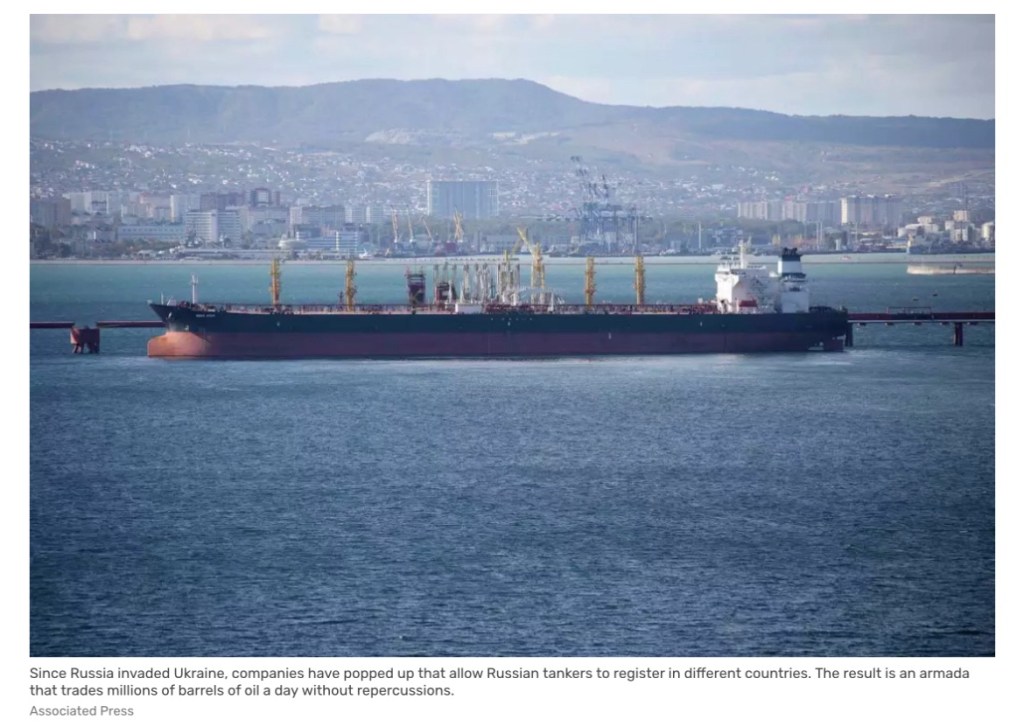
Russia resorts to similar systems to steer clear of sanctions on its oil trade and hide any connection the cargoes have to Moscow. Since the start of Russia’s full-scale invasion of Ukraine two years ago, several companies have popped up in India, Gabon, Laos and the United Arab Emirates that allow Russian tankers to register in different countries. The result is an armada that trades millions of barrels of oil a day without repercussions.
Washington and the international community must tackle these challenges to sanctions’ effectiveness. It is critical we keep illicit funds generated from the black-market energy trade out of the hands of authoritarians and bad actors in places such as Iran and Russia. These efforts must start at home because Western companies have become service providers facilitating the transportation of forbidden oil products. This is often inadvertently because of the secrecy and difficulty in connecting oil exports to sanctioned countries.
A recent New York Times investigation found that a U.S.-based insurance provider, the American Club, was involved in trading over 59 million barrels of Iranian oil in 2023. Similarly, a U.K.-based insurer had links to approximately 33% of all Russian oil exports between the early phases of the invasion of Ukraine and November 2023. Maritime insurance is essential to oil-exporting countries since most ports require ships to provide proof of coverage before conducting business trade.
The strategy behind enforcement makes the problem more challenging for sanctioning countries. Rather than empowering the appropriate sanctions-supervising bureau, governments largely rely on the private sector to ensure that no targeted actors violate existing controls.
Read full report: https://www.houstonchronicle.com/opinion/outlook/article/iran-russia-evade-oil-sanctions-19388021.php
 Financial Crime News Briefs