
Reported by Tara Siegel Bernard
Social Security-related scams, overall, are pervasive — fraudsters pose as employees to try to extract both money and valuable identifying details from people in a variety of evolving schemes. But this particular fraud — where criminals use stolen personal information to break into online Social Security accounts or create new ones, and divert benefits elsewhere — has plagued people for a more than a decade.
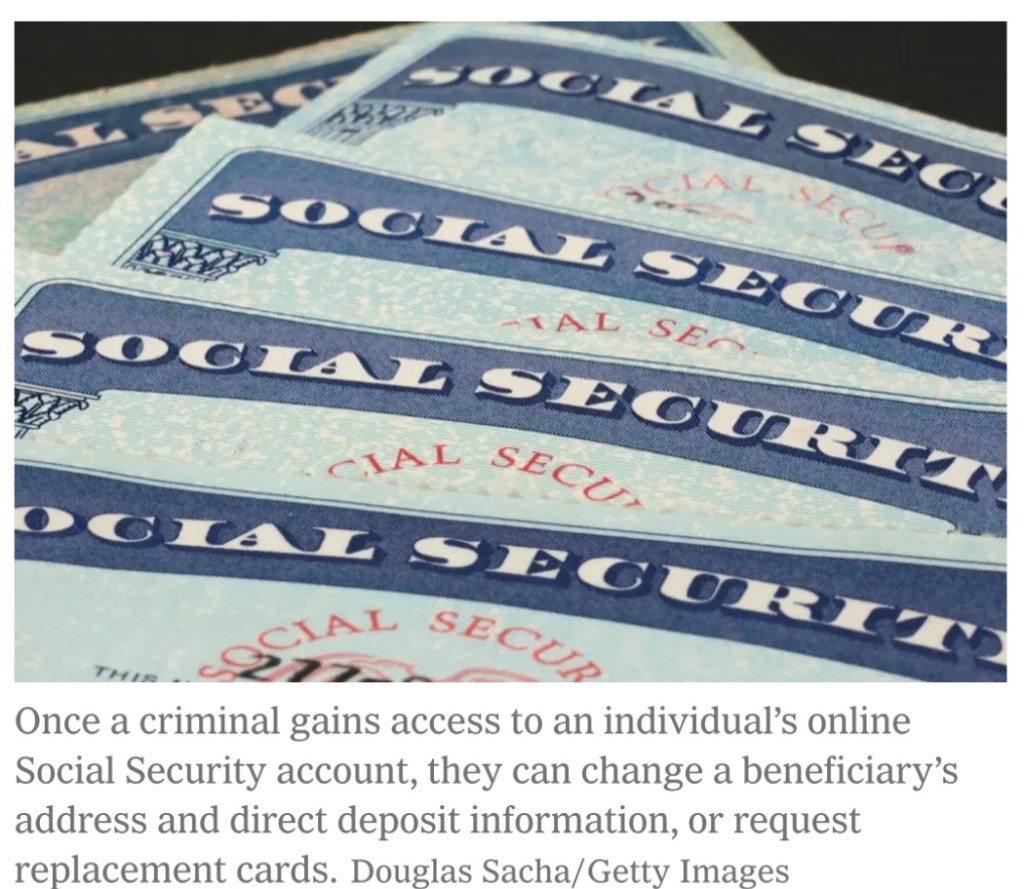
Once fraudsters gain access to an individual’s online Social Security account, they can change a beneficiary’s address and direct deposit information, or request replacement cards.
Nearly everyone is a potential target. The Social Security Administration sends checks to more than 70 million beneficiaries, including retirees and disabled people, totaling nearly $120 million every month. An estimated 2,000 beneficiaries had their direct deposits redirected last year, according to anti-fraud officials at the Social Security Administration.
Criminals collect the personal identifying information they need in any number of ways, which they later use to break into government accounts or create fraudulent ones. You need a Social Security number to establish an online account with the agency, but you don’t need the entire nine-digits to crack open an existing one.
Amy Nofziger, director of fraud victim support at AARP Fraud Watch Network, recently scanned through her database of cases and came across a handful of victims who had a third-party snag their Social Security number within the past six months. One unsuspecting person gave it to an impostor promising insurance subsidies. Another criminal posed as a representative of the victim’s bank. In yet another case, the fraudster pretended to be calling from a credit bureau to verify the victim’s Social Security number.
Sometimes identity thieves claim they’re calling from a doctor’s office, and in other instances they’re able to compromise a person’s device and collect valuable information, such as passwords or other personal details saved.
When gathering various pieces of a person’s identity, fraudsters may also turn to marketplaces on the dark web, where much personal identifying information — often stolen through security breaches — is for sale.
Pam Dixon, executive director of the World Privacy Forum, a research group focused on data governance and protection, said people living in medical or assisted living facilities were also often vulnerable to these crimes. “It is among the ugliest forms of identity theft,” she added.
How to Protect Yourself From Social Security Fraud
Consider locking down your accounts. Create a my Social Security account, but then add an e-services block, a feature that prevents anyone, including you, from seeing or changing your personal information online. You will need to contact your local office to remove it.
Another feature, a direct deposit fraud prevention block, stops anyone from enrolling in direct deposit, or changing your address or direct deposit information through your online account or a financial institution. You must contact a local office to make any changes or to remove the block.
Don’t trust, also verify. If your phone’s caller identification says “Social Security Administration,” don’t trust it — the number may be spoofed and the agency only callsbeneficiaries in limited situations. Call back the agency through its mainline 1-800-772-1213 or call a local site using its office locator.
Report suspected scams and fraud to the Office of Inspector General’s website or call 1-800-269-0271.
Contact the Federal Trade Commission if you suspect someone has used your personal information, either throughits website or calling 1-877-IDTHEFT (1-877-438-4338).
Review the Social Security Administration’s resource page on how to spot scams.
Read full report: https://www.nytimes.com/2024/03/09/business/social-security-scams.html
 Financial Crime News Briefs