
Reported by Vivian Nereim and Tariq Panja
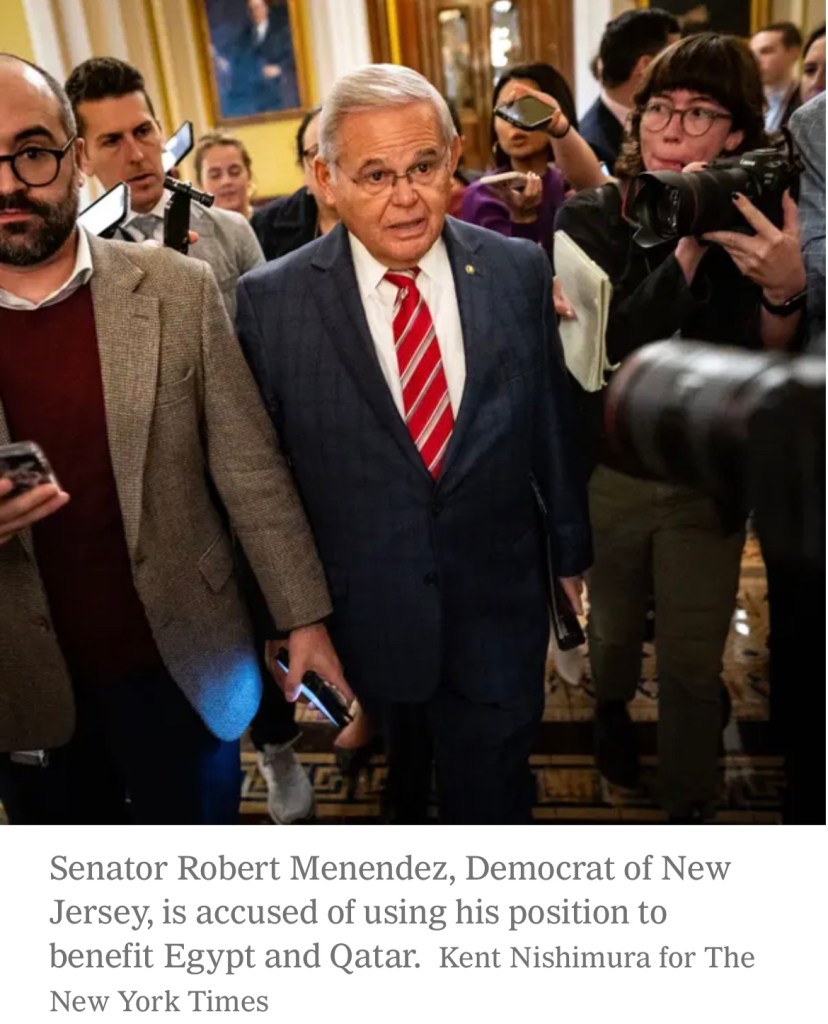
When Senator Robert Menendez arrived in Qatar in 2022 to attend the country’s lavish production of the men’s soccer World Cup, he gave an unusual interview to the authoritarian government’s news agency praising the progress that Qatar had made on labor rights.
The tiny Gulf state was facing an onslaught of international criticism over its preparations for the world’s biggest sporting event, including over the exploitation of migrant workers who built the tournament’s infrastructure. But Mr. Menendez, a New Jersey Democrat, said he preferred to highlight positive aspects of the games, and the host nation.
Less than a year later, Mr. Menendez, 70, was charged in a federal indictment with taking hundreds of thousands of dollars in bribes, including bars of gold, to wield his power at home and abroad. The case initially focused on actions that benefited Egypt. But on Tuesday, updated court documents added new details related to Qatar.
In the updated indictment, prosecutors accused Mr. Menendez of using his influence and connections — a byproduct of his powerful position as the chairman of the Senate Foreign Relations Committee — to help a New Jersey developer get financial backing from an investment fund run by a Qatari royal family member in exchange for lucrative bribes.
To help win over the Qataris, prosecutors said, the developer, Fred Daibes, also expected Mr. Menendez to “take action to benefit the government of Qatar.”
And while the indictment does not accuse the Qatari government or the Qatari royal family member of illegal activity, it is the latest in a line of cases in which Qatar, a major natural gas exporter, has appeared to seek greater influence in the United States and Europe by forging relationships with powerful government officials, or people connected to them.
On Tuesday — the same day that the updated indictment was released — Barry Bennett and Doug Watts, Republican political consultants, admitted in court filings to violating American foreign influence rules over their lobbying activities on behalf of Qatar. That case came just over a year after Belgian authorities announced charges against a vice president of the European Parliament, saying that she had traded political decisions benefiting Qatar for bags of cash.
Qatar, shadowed for years by accusations it had used bribery to win the World Cup hosting rights, has denied that it sought to influence the European official, who has also maintained her innocence.
To analysts who study the Gulf, though, such cases are pieces of a broader picture, and a window into how the region’s fossil fuel-rich states transform their wealth into political poweraround the world.
Read full report: https://www.nytimes.com/2024/01/03/world/middleeast/menendez-indictment-qatar.html
 Financial Crime News Briefs