
Reported by Paul Mozur, Aaron Krolik and Adam Satariano
Shortly after Russia invaded Ukraine last year, engineers at Convex, a Russian telecommunications company, needed to find American equipment to transmit data to the country’s feared intelligence service. But no gear was flowing in after Western nations imposed sweeping new trade limits on Russia.
Convex’s employees soon found a solution.
While Cisco, a U.S. tech provider, had halted sales to Russia on March 3, 2022, Convex’s engineers easily obtained the Cisco gear they needed through an obscure Russian e-commerce site called Nag, which had gotten around international trade restrictions by buying the American equipment through a web of suppliers in China.
Convex engineers then visited the offices of Russia’s Federal Security Service, known as the F.S.B., in Yekaterinburg to install the gear that would help categorize and send data to the authorities. “Coordinate with the F.S.B. the placement of the Cisco Catalyst WS-C4948E switch,” a Convex engineer wrote on March 23, 2022, according to a company communications log obtained by The New York Times.
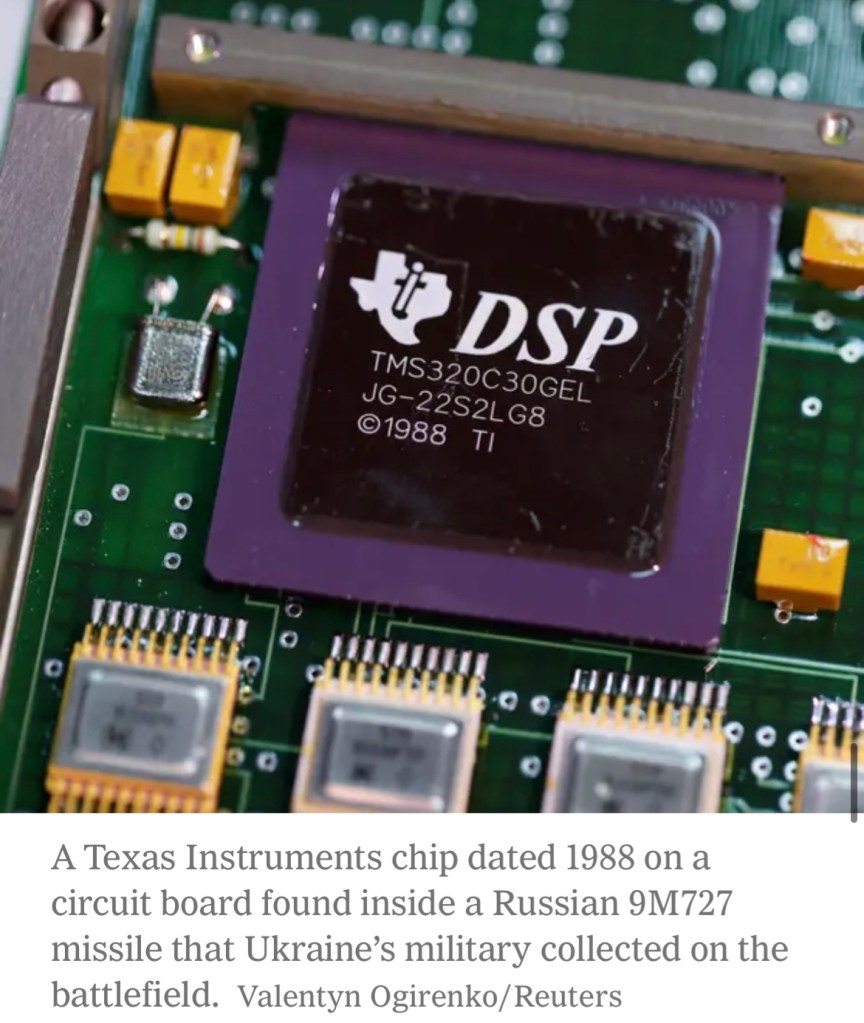
In the 22 months since the war in Ukraine began, Russia has largely continued getting the technology it needs to keep its economy running. After export restrictions and corporate bans initially led to trade disruptions, Russian suppliers found loopholes and cultivated workarounds. Almost no piece of commercial hardware — including basic telecom equipment, surveillance gear, microchips for advanced computing and weapons systems, and drones — has been too hard to get.
Russian authorities and companies have united to take advantage of cracks in the global response. They have tapped webs of intermediaries, including middlemen in China, and disguised their activity through shell companies, according to leaked Russian government emails, trade documents and records of online conversations between Russian engineers obtained by The Times.
They have also turned to countries that have staked out neutral positions in the conflict, such as Morocco and Turkey, and used their ports to receive goods from global tech manufacturing centers that are then placed on other ships headed toward Russia, a process known as transshipment. The prohibited tech products were then made available to buy from well-known suppliers and on easy-to-use e-commerce sites like Nag.
Flexibility has been paramount. In weekly emails, Russian trade officials shared tips on which ports would transfer goods, who would trade in rubles and where Russian-flagged ships could be repaired, the documents show. If one supplier stopped selling, they found another. If a shipping route was cut off, new ones took up the slack.
The documents offer a rare glimpse of a race in which Russian traders have reliably stayed one step ahead of U.S.-led efforts to cut them off. Their success shows how difficult it is to stop the global movement of commercial technology, raising questions about the effectiveness of Western trade restrictions and whether tech giants should better control the destinations of their products — and if it is even possible to do so.
Cisco declined to comment. Convex did not respond to requests for comment.
Understaffed government investigators in the United States and Europe cannot keep pace with the often shadowy flow of goods, said Elina Ribakova, an economist who has studied sanctions evasion at the Peterson Institute for International Economics, a U.S. think tank. Major tech companies, she added, must do more to cut off supplies to Russia.
Read full report: https://www.nytimes.com/2023/12/19/technology/russia-flouts-global-tech-bans.html
 Financial Crime News Briefs