
Reported by Tara Siegel Bernard
What was once a routine way to pay your bills — handwriting paper checks at the kitchen table, dropping envelopes into a blue metal box on the street — has become a high-risk endeavor: It provides the raw materials for low-level fraud artists and sophisticated crime rings, costing financial institutions billions. It has put banks on high alert, though their efforts to catch the fraud also routinely entangles innocent customers, causing institutions to suddenly freeze or shut down customer accounts in the process. Many of the bad guys manage to disappear without any consequences.
Even as check usage has rapidly declined over the past couple of decades, check fraud has risen sharply, particularly since the pandemic. The cons may start with stealing pieces of paper, but they leverage technology and social media to commit fraud on a grander scale, banking insiders and fraud experts said. In the past, criminals needed a special internet browser that would grant entry into the dark web marketplace of stolen checks, maybe even someone to vouch for them — now all they need is an account from Telegram, a messaging app.
“You can buy checks on the internet for $45, with a perfectly good signature,” said John Ravita, director of business development at SQN Banking Systems, which provides check fraud detection software. “There is one website that offers a money-back guarantee. It’s like Nordstrom.”
A recent surge in mail theft caused the Financial Crimes Enforcement Network — an arm of the Treasury Department known as FinCEN that is charged with safeguarding the financial system — to sound alarm bells this year. Thieves have attacked mail carriers, or stolen and sold carriers’ arrow keys, which unlock mailboxes within a certain area. The checks are stolen from the mail, and then criminals carry out a classic fraud: “washing” the checks using something as basic as nail polish remover, leaving the signature untouched. Others “cook” new checks by scanning and altering the old ones.
Some criminals deposit checks into their own accounts, while others list them for sale. But the schemes have grown sophisticated: Not only can thieves buy stolen checks, they can purchase bank accounts in which to deposit them, along with the mobile phone number and device used to create that account, among other things.
Banks and credit unions are expected to file nearly 540,000 suspicious activity reports tied to check fraud this year, a record, according to a Thomson Reuters analysis of data from FinCEN. That’s about 7 percent higher than 2022, but more than double the levels in 2021, when fewer than a quarter-million such reports were filed.
Regions Financial in Birmingham, Ala., has filed its fair share: Last month, it admitted to Wall Street analysts that it had become entangled in a check scheme that went undetected for long enough that its fraud costs — $136 million so far in 2023 — would double this year.
Regions was the victim of two schemes this year. In one, criminals heard that the bank was giving its customers quicker access to money deposited from checks. “We opened the door too wide, bad people came rushing in, and we didn’t close the door timely enough,” Mr. Turner said. “What happens is they get on the dark web and they start talking to each other, and they just overwhelm the system.”
David Maimon, a criminal justice professor and director of a cybersecurity research group at Georgia State University, acts like a secret agent, watching the deals that take place on dark corners online, where criminals brazenly advertise their stolen checks using code words. The number of stolen checks circulating escalated during the pandemic, he said, when scam artists figured out how easily they could pull off such crimes.
In September, Professor Maimon’s group found nearly 9,148 stolen checks circulating in 80 select Telegram markets, up from 4,527 in February.
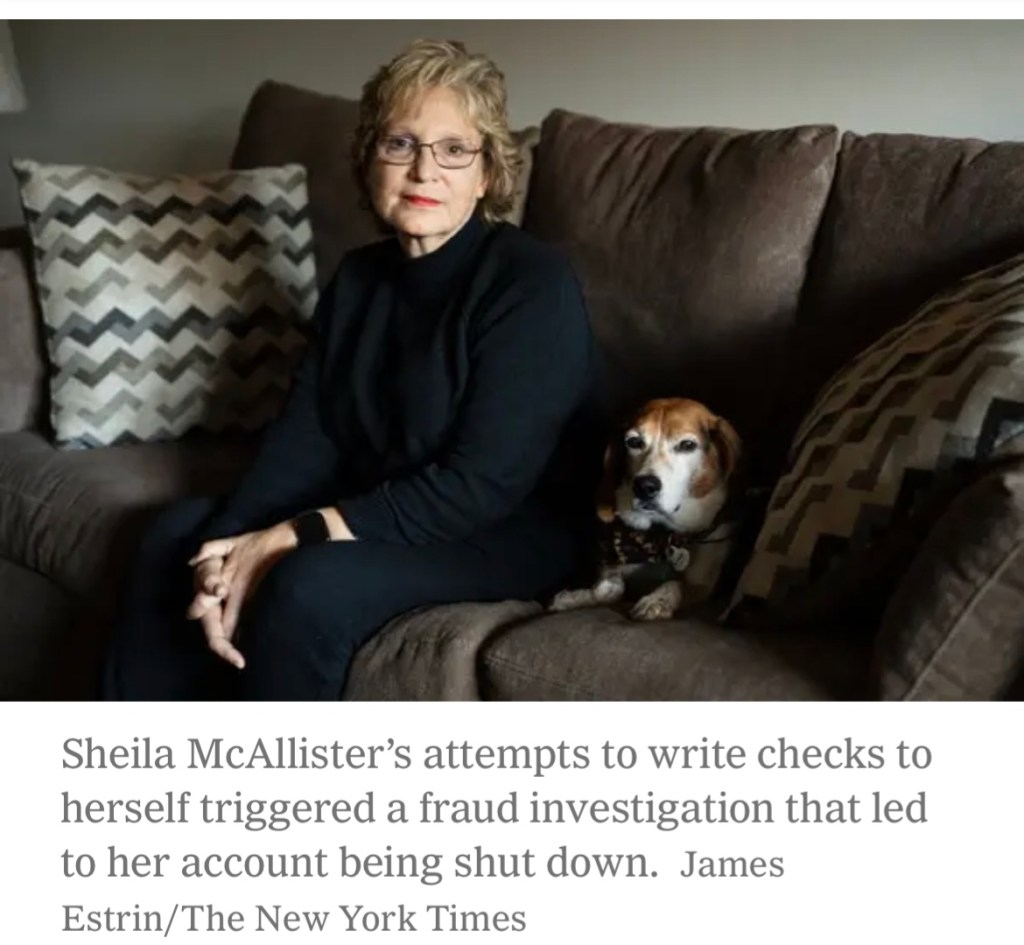
At the same time, bank anti-fraud measures, however well-intentioned, may misfire, turning consumers’ financial lives upside down.
Read full report: https://www.nytimes.com/2023/12/09/business/check-fraud.html
 Financial Crime News Briefs