
Reported by Kate Kelly
Three years ago, when Congress passed an anti-corruption law intended to help combat money laundering through shell companies, it drew bipartisan support.
Senator Sherrod Brown, Democrat of Ohio, called it “long overdue.” Senator Marco Rubio, Republican of Florida, called it an “important provision” that would help law enforcement agencies crack down on human trafficking and terrorist financing.
Now, just weeks before a central aspect of the Corporate Transparency Act is to take effect, it is under assault by interest groups and ideological foes who say it will not work as intended and will put too great a burden on tens of millions of small businesses.
The intense opposition underscores a little-recognized element of how Washington works: The passage of a law does not always end the battle over divisive issues.
Once a bill is made law, its implementation is frequently turned over to a government agency. That agency can then spend years determining the details of how to apply the legislation, providing an opening for more lobbying, litigation and other actions that can reshape the law in meaningful ways.
In the case of the Corporate Transparency Act, the Treasury Department is in charge of implementation. The department is under pressure to revise its approach from small business and financial trade groups, who object to the costs and bureaucratic complexities they say it would impose.
The law’s intention is to deter money laundering or the channeling of money to terrorist groups by exposing who is behind firms set up for or being used for those purposes. It exempts most big businesses, where ownership is already reasonably well documented, but places a number of new reporting requirements on many small and newly formed firms.
One small business group is suing Treasury Secretary Janet L. Yellen over her agency’s interpretation of the law, calling it unconstitutional. Senior Republicans in the House and the Senate have proposed delays.
At issue is the law’s definition of a reporting requirement known as “beneficial ownership” — or who actually owns or controls companies.
To drive the small-business message, Todd McCracken, president and chief executive of the National Small Business Association, and his board found a small real-estate investor and manager in Huntsville, Ala., to help the group sue the government over the new rules.
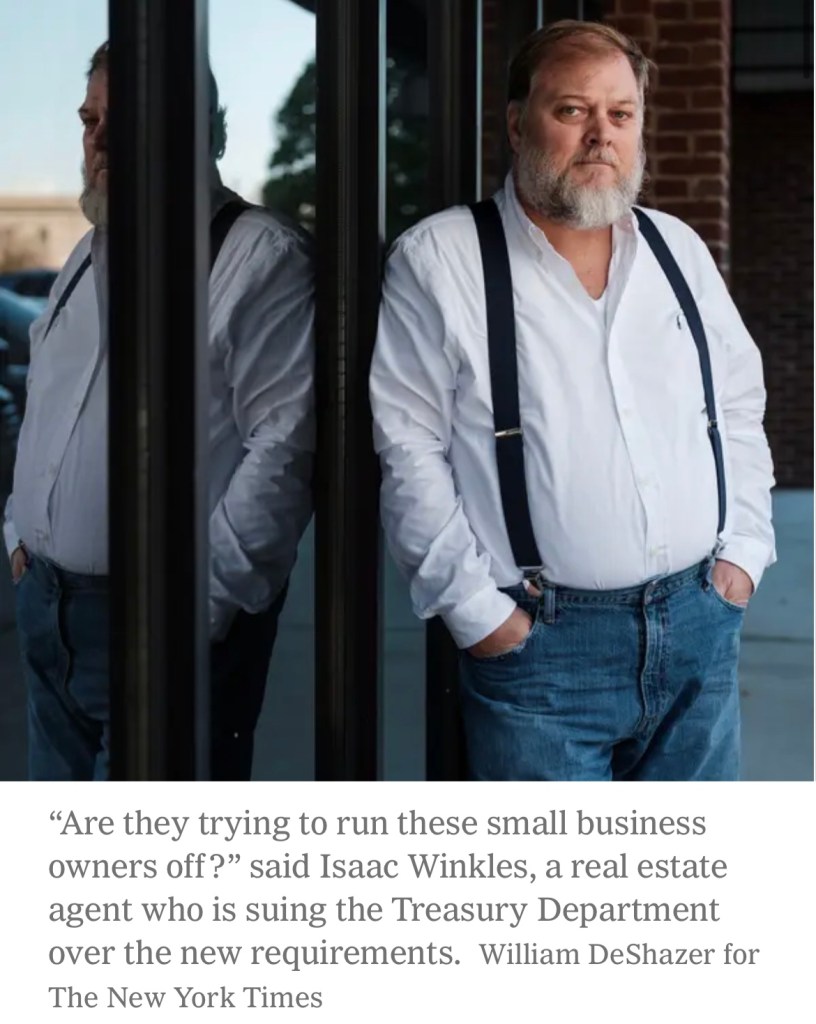
The real-estate manager, Isaac Winkles, is now the co-plaintiff in the association’s federal lawsuit against Ms. Yellen, her agency and the former acting head of the Treasury Department’s Financial Crimes Enforcement Network, known as FinCEN. Mr. Winkles predicted that complying with the new disclosures would be costly to his business and said it had already led to hassles in securing credit from his local banks.
“Are they trying to run these small business owners off?” Mr. Winkles asked in a recent interview. “There are other ways to get that information than having to put another undue burden on small business, for sure.”
Read full report: https://www.nytimes.com/2023/12/07/us/politics/corporate-transparency-act-lobbying.html
 Financial Crime News Briefs