
Reported by VICTOR JACK AND GABRIEL GAVIN
A Western effort to cap Russia’s oil revenues after Moscow launched its war on Ukraine has essentially failed a year since it was first agreed, a new report seen by POLITICO found, prompting renewed pleas from Kyiv for its allies to take tougher action.
G7 nations and the EU imposed a $60-per-barrel ceiling on Russian crude oil last December in an attempt to keep oil supplies stable globally while starving the Kremlin’s war chest. But widespread circumvention, gaping loopholes and the ongoing fuel business mean Moscow is still earning billions from its flagship export that it can use to prolong the war.
It’s not that the price limit has had no effect. Over the last year, the scheme has cost the Kremlin €34 billion in export revenues, the equivalent of around two months of earnings this year, according to the new analysis from the Centre for Research on Energy and Clean Air (CREA) think tank shared with POLITICO.
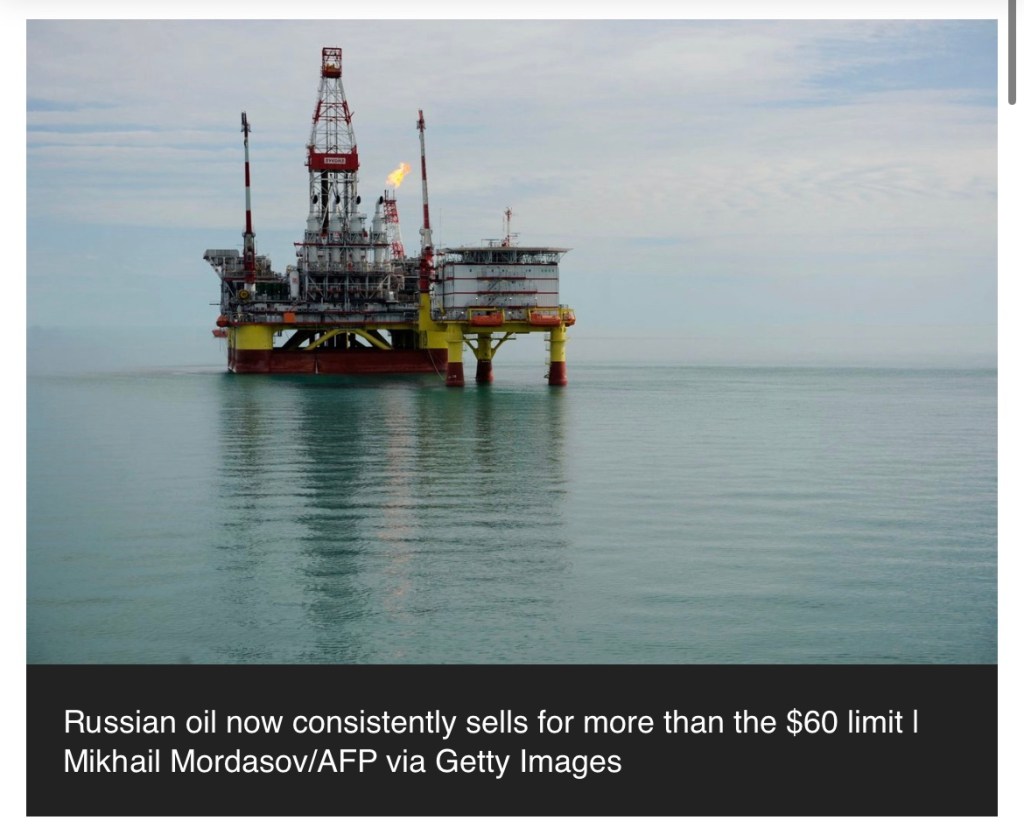
But that’s far less than those who designed the rules had hoped; moreover, the impact was felt most intensely in the first half of 2023 before beginning to fade. Russian oil now consistently sells for more than the $60 limit.
“The impact of the price cap has been limited due to inadequate monitoring and enforcement,” said Isaac Levi, who leads CREA’s work on Europe and Russia, with Western nations failing to crack down on sanctions loopholes.
The shortfall is partly due to traders simply ignoring the price ceiling, the report states, and Russian oil is selling for roughly $70 a barrel. Around 48 percent of Russian oil cargoes were carried on tankers owned or insured in G7 and EU countries, the researchers found; in theory, the price cap should apply to these vessels, which comprise the vast majority of the global fleet — but in practice, few operators have been targeted.
A “refining loophole” has also undermined Western efforts. Countries like India are buying huge volumes of Russian crude on the cheap, processing it and then selling it to anyone who wants it, without restrictions. That means European consumers could unknowingly be using petrol, diesel and jet fuel produced from Russian crude, bankrolling Moscow’s armed forces at the same time.
Read full report: https://www.politico.eu/article/russia-oil-price-cap-ukraine-war-centre-research-energy-clean-air/
 Financial Crime News Briefs