
Reported by Penny Corpsman
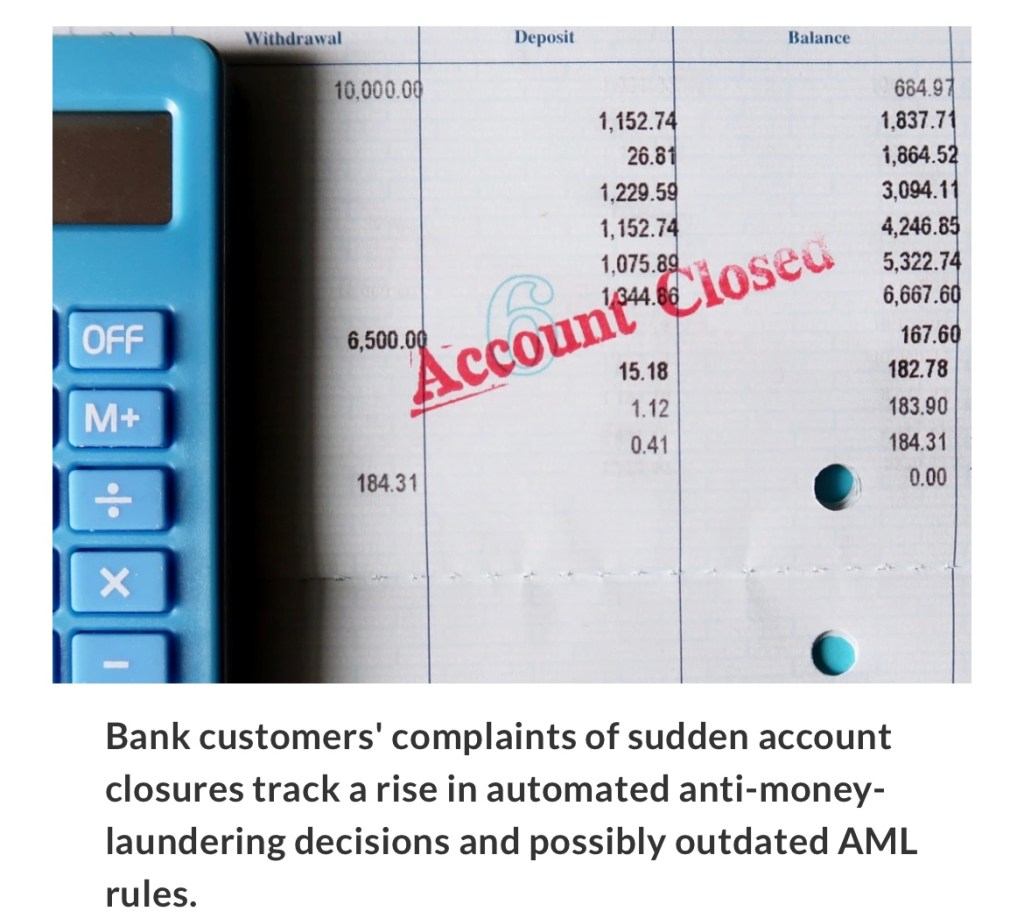
In an effort to become more efficient, large banks increasingly automate anti-money-laundering and fraud detection work, and centralize decision making among a small group of people far removed from customers. Innocent customers can get caught up in the rush, and they often have little to no recourse if their accounts are flagged or closed.
Earlier this year, out of the blue, The New York Times’ Your Money columnist Ron Lieber received hundreds of complaints from bank customers who said their bank accounts had been suddenly shut down without explanation. He wrote a story about one bank customer’s experience and put out a call to readers, asking if this had happened to them.
Lieber and his colleagues received more than 1,200 complaints. Most were customers of large banks writing to complain about checking account closures. Lieber told the stories of six of these people in a November article. One customer had been a convict ten years earlier. Another received money from family members in Nigeria. A couple who owned several New York City bars deposited money into their bank account on Mondays and Fridays, often rounding down to the nearest thousand and keeping the rest of the cash on hand to make change.
Former anti-money-laundering executives at banks and other experts say there are a few reasons for this apparent rise in account closures. One is a heavy reliance on AML software to monitor transactions overseen by decision makers who don’t know individual customers. Another is outdated rules used to determine which transactions are suspicious. A third is a set of incentives that push banks to rush and not take the time to understand individual cases.
Advanced AI technology could help, some say. AI-based transaction monitoring software could discern that a customer’s behavior may be different from others in a category, but is not criminal.
Quest for efficiency
At one large bank, “everything we did was to make it more efficient for the bank,” said Aaron Ansari, a former AML executive, in an interview.
If AML software determined an account had tripped up several preset AML rules, the account would automatically get shut down and the software would generate a notification letter or email to the customer, Ansari said.
“The number of customers that you lose is minuscule compared to the efficiencies and the regulatory headaches that you would get if you continue to service those accounts,” Ansari said. “It never makes sense to make an exception. I never saw an exception.”
Once software detected suspicious activity, there was no way for customers to dispute the account shutdown.
“For years, the decisions have been so heavy-handed, so de-risking,” Ansari said. “The business justification is that it’s much easier for us to close and to cancel than it is for us to mitigate and deal with the humanity of things.”
Read full report: https://www.americanbanker.com/news/rushed-anti-money-laundering-calls-backfire-can-ai-help
 Financial Crime News Briefs