
Reported by JOSEPH BOUCHARD
It’s been a tumultuous two weeks in Venezuela.
First, the Biden administration and the Maduro government signed a deal exchanging democratic guarantees for sanctions relief on oil, natural gas, and gold mining — some of Venezuela’s largest industries. With the sanctions lifted, Maduro allowed the opposition’s primary election to go ahead.
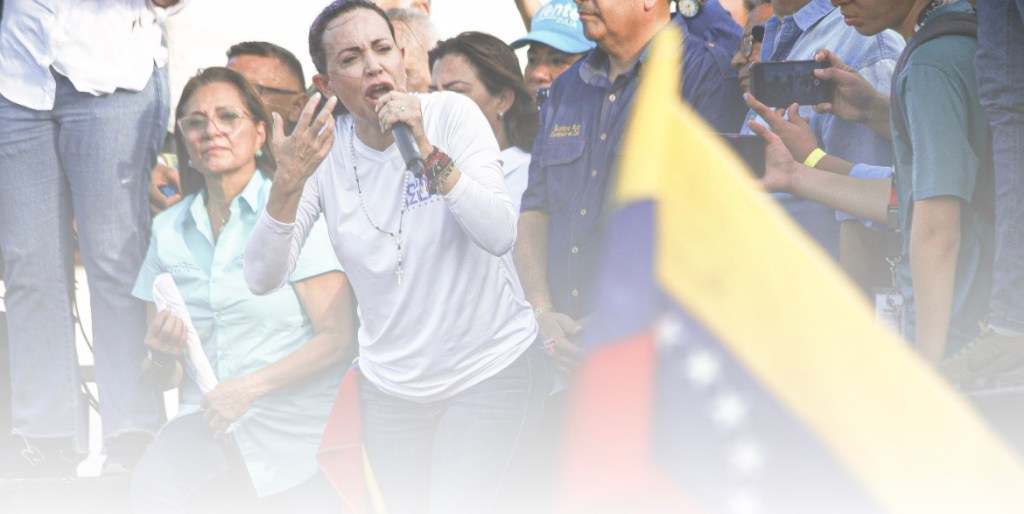
María Corina Machado, a classical liberal who calls herself the “Iron Lady of Venezuela” and went through the same Yale program as Russian dissident Alexei Navalny, won the election with an astounding 93 percent of the vote. Venezuelans overwhelmingly showed up to vote, doubling the expected turnoutof 1 million ballots.
Maduro quickly declared the election illegitimate and labeled Machado a puppet of U.S. interests, going directly against the sanctions relief deal.
The U.S. and Machado have expressed little intention beyond rhetoric to reinstate sanctions. After all, the U.S. is in desperate need of oil, and Venezuela has plenty to offer. Unless the U.S. can establish direct incentives for Maduro and his regime to make democratic reforms, a peaceful path to democratization is highly unlikely.
If anything, Maduro has shown his willingness to keep sanctions on to push for specific geopolitical demands while maintaining his domestic anti-U.S. message. In 2021, Maduro suspended all negotiations with the U.S. over the imprisonment of Colombian financier Alex Saab. Despite that, the U.S. went ahead with some sanctions relief soon after.
Maduro has created an alternative economy for Venezuela, where illicit markets make up for over one fifth of all of the country’s GDP. With oil revenues currently standing at $9.3 billion annually, sanctions relief would only lead to “a moderate increase in Venezuelan oil production,” according to Dr. Francisco Monaldi of the Baker Institute. Alternatively, the Maduro regime has increasingly looked to other economic opportunities to ensure its permanency.
After being pushed out of the international financial system, Venezuela has grown its commercial, financial, diplomatic, political, and security relationship with other sanctioned regimes, including Iran, China, Russia, Nicaragua, and Cuba, which have themselves contested the results of the opposition election and reiterated support for Maduro.
More states with a nominally anti-Western posture, such as Bolivia, South Africa, Turkey, and Ethiopia, are also providing some support given that some of their interests align with Maduro’s. These relationships lead to a circle of mutual assistance wherein the leaders’ political survival is ensured through a permanent flow of commerce and cash between these regimes.
These states now have a vested interest in preventing an adversary to their interests from entering the Palacio de Miraflores, and Maduro knows it. Sanctions are much less harmful to the regime than they were years ago.
Maduro’s calculation is simple: Whether he decides to hold a fully democratic election against Machado, a sham election like in 2018, or to fully overtake the country through military force, Maduro will have sufficient support on his side. Credible polls show Maduro has the backingt of 58 percent of voting intentions (compared to Machado’s 23 percent), with many in the resistance, particularly those with the financial capability to organize contestation efforts, having already left the country.
Whether the U.S. foreign policy establishment likes it or not, Maduro, like his predecessor Hugo Chávez, will use any foreign pressure the U.S. decides to undertake to his political advantage. If sanctions are lifted, Maduro will keep attacking the opposition while boasting about his negotiating genius. If sanctions are put back on, Maduro will parade as a martyr again to his crowd of adoring supporters, meanwhile using the tried-and-tested alternative global order offered by sanctioned regimes to ensure the regime’s security.
Some left-wing governments in the region are also offering rhetorical and material support to Maduro, heightening the regional cost of regime change. With this deal and other domestic political wins — including slashing the poverty rate by a quarter in two years, regaining international recognition, and raising oil production— Maduro’s support will likely consolidate.
The regime also has the added benefit of violent support from the colectivos (pro-Maduro thugs who intimidate the opposition), the military and intelligence services, drug cartels, the state mediaapparatus, and a number of foreign governments. On the off-chance that Maduro ultimately loses the election, these interests might collectively ensure that a peaceful transition of power is impossible without significant military involvement from the West — cooperation that the West is likely unwilling or unable to offer.
Maduro’s rise to power demonstrates how difficult he will be to unseat.
Read full report: https://responsiblestatecraft.org/maduro-machado-venezuela/
 Financial Crime News Briefs