
Reported by Walt Bogdanich, Isak Hüllert and Eli Tan
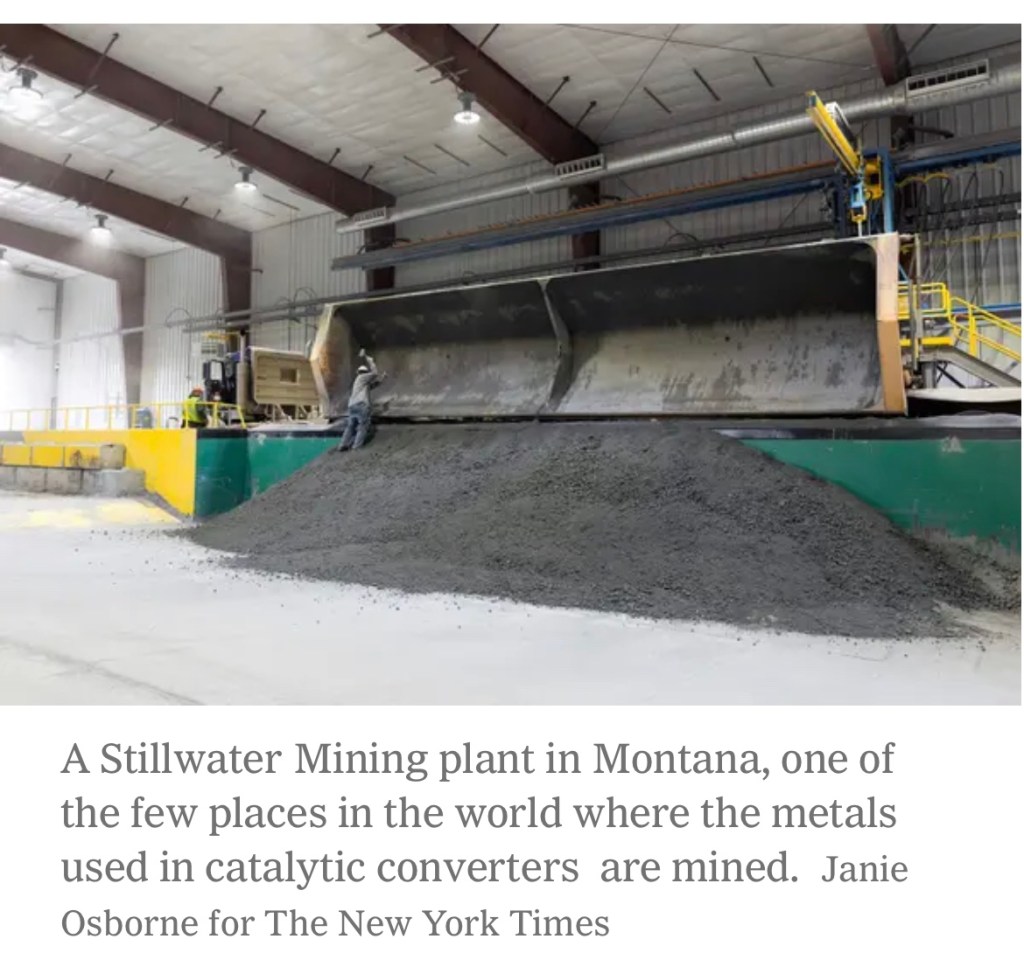
One morning in September, a truck disgorged its load of pulverized rock with a resounding bang inside Stillwater Mining’s metallurgical plant north of Yellowstone National Park.
The mined ore contains platinum, palladium and rhodium, three of the earth’s rarest, most expensive metals — and vital components in the millions of catalytic converters that reduce polluting emissions from gasoline-powered vehicles.
At the opposite end of the plant was another batch of metal, not from the mine but from used catalytic converters ground into powder for recycling. The new and the old metals would later be blended under intense heat, then shipped to a refinery.
Recycling catalytic converters costs less than mining the ore. But it carries a risk, as Stillwater discovered after paying more than $170 million for used ones, many of them stolen, according to an indictment handed up this spring on Long Island that implicated the mine. Stillwater was not charged and denied knowing the devices were stolen.
The indictment is an outgrowth of a billion-dollar epidemic of catalytic converter thefts that has not only disabled vehicles but also involved dozens of shootings, truck hijackings and other violence. Replacement devices are often hard to get and can cost $1,000 or more.
Despite public attention on the thefts, little has been known about where the stolen metal goes, who benefits or why stopping the thievery has proved so difficult.
An examination of business records and social media posts, as well as interviews with more than 80 officials on three continents who have ties to the industry, showed that the stolen devices pass through middlemen, smelters and refineries in the United States and overseas. Along the way, their provenance becomes opaque, leaving beneficiaries of the thefts with plausible deniability and little incentive to stop them.
During processing, the metal is blended with legitimate supplies from mines and scrapyards, The New York Times found, before being sold primarily to companies that make catalytic converters for automakers, as well as pharmaceutical companies for cancer and other drugs, military contractors for weapons production, and banks for their precious-metals trading desks, among others.
By then, it is nearly impossible to separate what’s legal from what’s not.
Banks provide short-term financing to process the metals, while other lightly regulated lenders, sometimes called “shadow bankers,” step in when the big banks won’t, Mark Williams, a former Federal Reserve Bank examiner, said in an interview.
Read full report: https://www.nytimes.com/2023/11/14/us/catalytic-converters-thefts-recycling.html
 Financial Crime News Briefs