
Reported by Evan Halper, Dalton Bennett and Jonathan O’Connell
After Western nations announced bans on Russian oil last year in response to the invasion of Ukraine, a Greek refinery that serves the U.S. military moved quickly to adapt. Within months, it told investors it had stopped accepting the forbidden oil and had found other sources instead.
But there was a reason Russian petroleum, on paper at least, could so easily be removed from the supply chain.
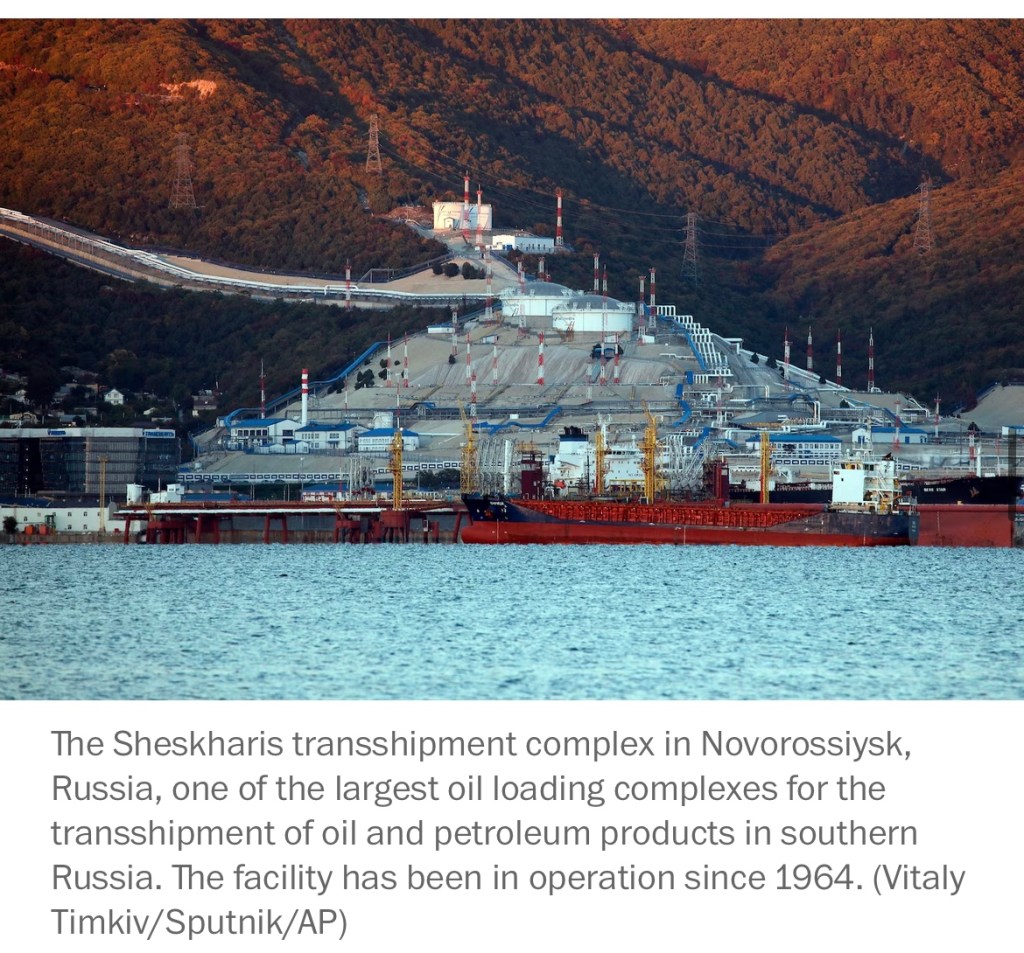
Petroleum products that originated in Russia kept flowing to the Motor Oil Hellas refinery on the Aegean Sea in Greece, a Washington Post examination of shipping and trade data found. They just took a new route, hundreds of miles out of the way through an oil storage facility in Turkey, a journey that obscured Russia’s imprint as ownership of the products changed hands multiple times before they reached Greece.
On the surface, the refinery’s sourcing of fuel oil from the Dortyol shipping terminal in Turkey seemed to affirm pronouncements by the White House and European leaders that embargoes on Russian oil were working as planned, depriving President Vladimir Putin of crucial revenue to fund his military aggression in Ukraine. The fact that those shipments contained material that originated in Russia underscores the porousness of the sanctions and the failure to aggressively enforce them.
The quantities of fuel oil shipped from Dortyol to Motor Oil Hellas, and the industry practice of mixing products of different origins as they are stored, ensure a large amount of product from Russia in the mix, according to industry experts with deep knowledge of oil flows and sanctions rules who reviewed the shipping and trade data at the request of The Post.
“I don’t see any other possible conclusion than Russian fuel is going to Motor Oil Hellas,” said Robert Auers, a refinery modeler and refined fuels market analyst at the research firm RBN Energy, who examined the Post findings.
The Post used shipping and other records to track the flow of fuel oil, a category of materials used to make products the Pentagon buys for ships and planes. The Project on Government Oversight, a nonprofit watchdog group based in Washington, surfaced some of those shipping records while preparing a reportwith information from Data Desk, a consulting firm that investigates fossil fuel companies.
Over the past two years, Dortyol received 5.4 million barrels of fuel oil by sea, all but 1.9 million from Russia, according to shipping records and trade data from Refinitiv, a financial-data firm that specializes in commodities markets. Since the European Union sanctions took effect in February, Russian shipments to Dortyol totaled 2.7 million barrels, or more than 69 percent of the fuel oil shipped by sea to Dortyol during that period.
Also since February, The Post found, Dortyol has shipped 7 million barrels of fuel oil overall, of which 4.2 million barrels went to Motor Oil Hellas. Those shipments accounted for at least 56 percent of all the fuel oil the Greek refinery received by ship.
The precise amount of Russian-origin fuel oil in the products the Pentagon purchases could not be determined. Those products are refined using multiple ingredients that cannot all be tracked through production.
It also could not be determined whether, at some point during its journey, the fuel oil from Russia was relabeled as having come from another country. The documents that describe the provenance of an oil shipment, known as certificates of origin, are not public records.
The Pentagon has inked nearly $1 billion worth of new contracts with the Greek refinery since the U.S. ban took effect in March of last year, federal contracting data show.
Since February, more than 1 million barrels of jet fuel from Motor Oil Hellas have also gone to government and corporate buyers in Italy, France, Spain and Britain, according to shipping records.
Joe Yoswa, a spokesman for the Pentagon’s Defense Logistics Agency, which handles fuel purchases for the U.S. military, said in an email that the agency has “no knowledge” of fuel from Russia being routed to its Greek supplier.
Read full report: https://www.washingtonpost.com/business/2023/11/14/russian-oil-sanctions-us-greece-turkey/
 Financial Crime News Briefs