
Reported by YAYA J. FANUSIE
Recent reporting about Palestinian terrorist groups accessing crypto assets points to an ongoing challenge: Terrorist organizations continue to exploit weak links across the financial system to raise, hide, and disperse funds. Many gaps exist, both with traditional financial actors and some crypto platforms that don’t effectively enforce the clear legal requirements that should keep members of terrorist networks away from their services.
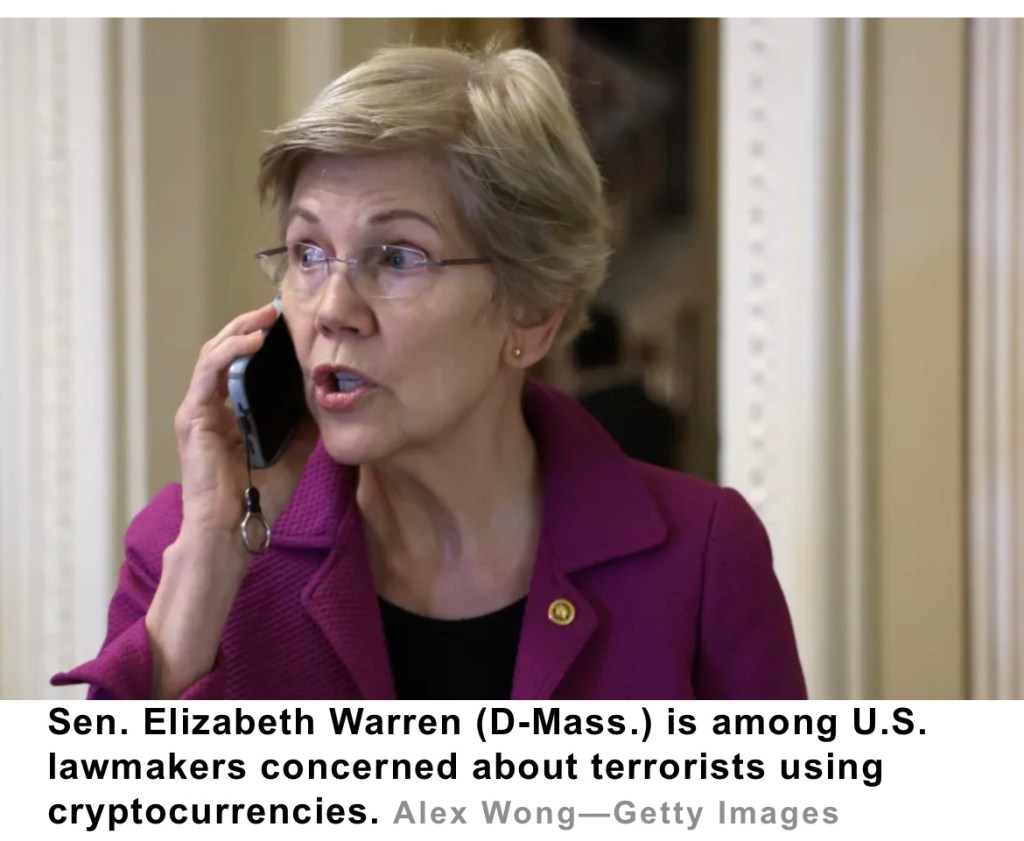
The recent proposal by more than 100 lawmakers, including Sens. Elizabeth Warren (D-Mass.) and Roger Marshall (R-Kans.), does nothing to address the problem of where more crypto-related crimes occur—overseas, and by unregulated actors. They are proposing KYC rules akin to suggesting that copy machine manufacturers would need to verify anyone using their copiers. The authors unfortunately fail to understand that the underlying blockchain technology actually makes transactions public, providing investigators a digital paper trail to identify terrorist operatives and their financial contributors. There are solutions.
Back in 2016, I started doing research on terrorist crowdfunding campaigns. In fact, the very first campaign I tracked was organized by a Palestinian militant network aiming to raise funds to purchase missiles and other weapons. The campaign was active for a few weeks and garnered only a little over $500 in Bitcoin. In the years that followed, a variety of terrorist groups, including Hamas, have become more familiar—and more sophisticated—when it comes to crypto. But it’s not at all clear that public crowdfunding has been the most reliable way to raise funds.
Crowdfunding is risky to those who have the gall to send funds to a terrorist group. In fact, earlier this year, Hamas’s military wing announced that it was suspending its Bitcoin campaign because the funding network suffered so many disruptions. It turns out that the public solicitation of crypto enabled security forces to easily track donations and go after Hamas supporters and its financial apparatus. In 2020, the Department of Justice reported how U.S. law enforcement conducted a covert operation to subvert a Hamas crypto campaign, take over its websites, and divert donations into U.S.-controlled wallets.
Given this reality, how could it be that Hamas and affiliated Palestinian terrorist groups have gained tens of millions in crypto?
Read full report: https://fortune.com/crypto/2023/10/20/stricter-verification-laws-in-the-u-s-wont-stop-international-terrorists-from-using-crypto/amp/
 Financial Crime News Briefs