
Reported by Aurelien Breeden
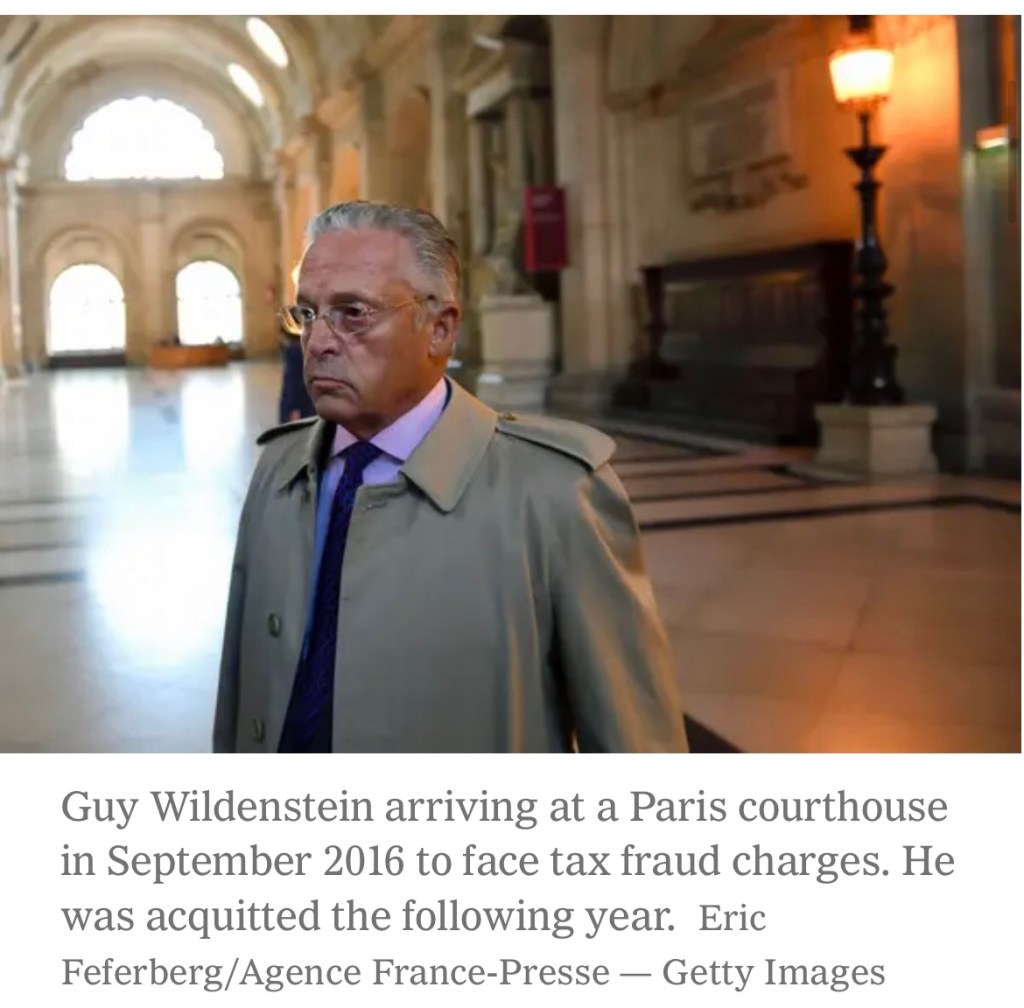
Guy Wildenstein, the international art dealer, is scheduled to return to court in Paris this week to face accusations of massive tax fraud and money laundering in a lengthy legal battle that has slowly chipped away at the prestige and secrecy of a family dynasty that once dominated the global art market.
French prosecutors are on their third attempt to convict Mr. Wildenstein, 77, whom they say hid significant chunks of his family’s storied art collection and other assets in a dizzying labyrinth of trusts and shell companies when his father, Daniel, died in 2001, and after his brother, Alec, died in 2008. The motive, according to the prosecutors, was to avoid paying hundreds of millions of euros in inheritance taxes.
Mr. Wildenstein, the Franco-American family patriarch and president of Wildenstein & Co. in New York, was acquitted of the tax fraud and money laundering charges in 2017. That ruling was upheld by a higher court but then overturned in 2021 by France’s top appeals court, which ordered a new trial to be held, beginning Sept. 18.
The Wildensteins, a family of French art dealers spanning five generations since the 1870s, were notoriously secretive about their collection, which included works by Caravaggio, Fragonard, Manet and many others.
As a result, there is no full accounting of the many masterpieces thought to be in a collection that has at various times been scattered across the globe. A Swiss free port, a nuclear bunker in the Catskill Mountains of New York, a former fire station in that state and a vault in Paris are among the many places parts of the collection have been stored. The family also has galleries in New York and Tokyo, as well as a prestigious research institute in the heart of the French capital.
But since the 2000s, repeated legal entanglements slowly lifted the curtain on the Wildenstein business, many of them the result of suits filed by women in the family who were cut off from its vast fortune during messy divorces and inheritance squabbles.
Claude Dumont Beghi, a lawyer who represented Sylvia Wildenstein, Daniel’s widow, over allegations that her stepsons cheated her out of her inheritance, said that the mounting legal woes were “a bit like a cluster bomb.”
State prosecutors allege that the Wildensteins were responsible for “the longest and most sophisticated tax fraud” in modern French history, by concealing art and other assets under complex trusts registered in far-flung places like the Bahamas or the Channel Islands, and by whisking away millions of dollars in artworks to tax havens.
Read full report: https://www.nytimes.com/2023/09/17/arts/design/wildenstein-art-tax-trial.html?searchResultPosition=9
 Financial Crime News Briefs